Facebook’s dark mode is turned on from the app or website settings: open Settings & privacy, choose Display and accessibility, select Dark mode, and switch it on. The wording and location can vary slightly by device, app version, account type, or Facebook layout, but the setting is available on most current phones, tablets, and desktop browsers.
Key Takeaways
- On an iPhone or Android phone, open Facebook’s menu, then go to Settings & privacy and Dark mode.
- On a computer, click your profile picture, open Display & accessibility, and choose On.
- Choose System instead of On if Facebook should follow your phone or computer’s light and dark appearance.
- Dark mode changes Facebook’s interface colors, but it doesn’t automatically darken every video, image, advertisement, or linked website.
- If the option is missing, update Facebook, restart the app, check the correct account, or try Facebook in a browser.
- Dark mode can reduce glare in dim surroundings, but it isn’t guaranteed to improve battery life on every screen.
Turn On Dark Mode Facebook
The fastest method depends on whether you use the Facebook mobile app or a desktop browser. The options below cover the usual layouts for iPhone, Android, Windows PCs, and Macs.
On iPhone or iPad
- Open the Facebook app.
- Tap the Menu button, usually shown as three horizontal lines or your profile picture.
- Tap Settings & privacy.
- Tap Settings if a submenu appears.
- Scroll to Preferences.
- Tap Dark mode.
- Select On.
On some iOS versions, Dark mode appears directly under Settings & privacy rather than inside a Preferences section. If you see System, select it to make Facebook follow the appearance setting selected for your iPhone or iPad.
On Android phones and tablets
- Open Facebook.
- Tap the Menu icon in the upper-right or lower-right corner.
- Open Settings & privacy.
- Tap Settings.
- Find Dark mode, often under Preferences.
- Choose On.
The Android menu can look different on Samsung Galaxy, Google Pixel, Motorola, OnePlus, and other phones because Facebook tests interface changes by account and app release. Look for terms such as Display, Appearance, Preferences, or Dark mode if the setting isn’t immediately visible.
On a computer browser
- Go to Facebook and sign in.
- Click your profile picture in the top-right corner.
- Select Display & accessibility.
- Find Dark mode.
- Select On.
Facebook normally saves this choice to your account and browser session. If you use multiple Facebook accounts, confirm that you changed the setting for the account you actually use.
Phone App Instructions
The mobile app is the most common place people look for this setting, but it’s also where Facebook’s menus change most often. Follow the general path first, then use the troubleshooting suggestions if a label is different.
Current app menu path
The usual path is:
Menu → Settings & privacy → Settings → Dark mode
Depending on the release, you may instead see:
Menu → Settings & privacy → Dark mode
Or:
Menu → Settings & privacy → Display & accessibility → Dark mode
Use the table below to identify the likely choice.
| Option | What it does | Best for |
|---|---|---|
| On | Keeps Facebook dark all the time | People who always prefer a dark interface |
| Off | Keeps Facebook light all the time | People who want the standard appearance |
| System | Follows your device appearance | Automatic day-and-night switching |
If you use Facebook Lite
Facebook Lite may have fewer settings than the full Facebook app. Open the menu and search for Dark mode, Appearance, or Display. If no option is available, use Facebook through your phone’s browser or install the current full Facebook app if your device supports it.
If you use Facebook in a mobile browser
Open Facebook in Safari, Chrome, Firefox, or another browser, sign in, and open the account menu. The mobile website may show the dark-mode option in a different place from the app. If it’s unavailable, your browser’s own dark appearance setting may not force Facebook to change.
Pro Tip: If you can’t find the setting, use the Facebook app’s internal search or your browser’s “find on page” command for dark mode. Search results vary by version, but this can reveal a setting that’s buried below several preference categories.
Desktop Website Instructions
Facebook’s desktop site generally places dark mode in a quick-access panel instead of requiring a long search through every settings category.
Standard desktop steps
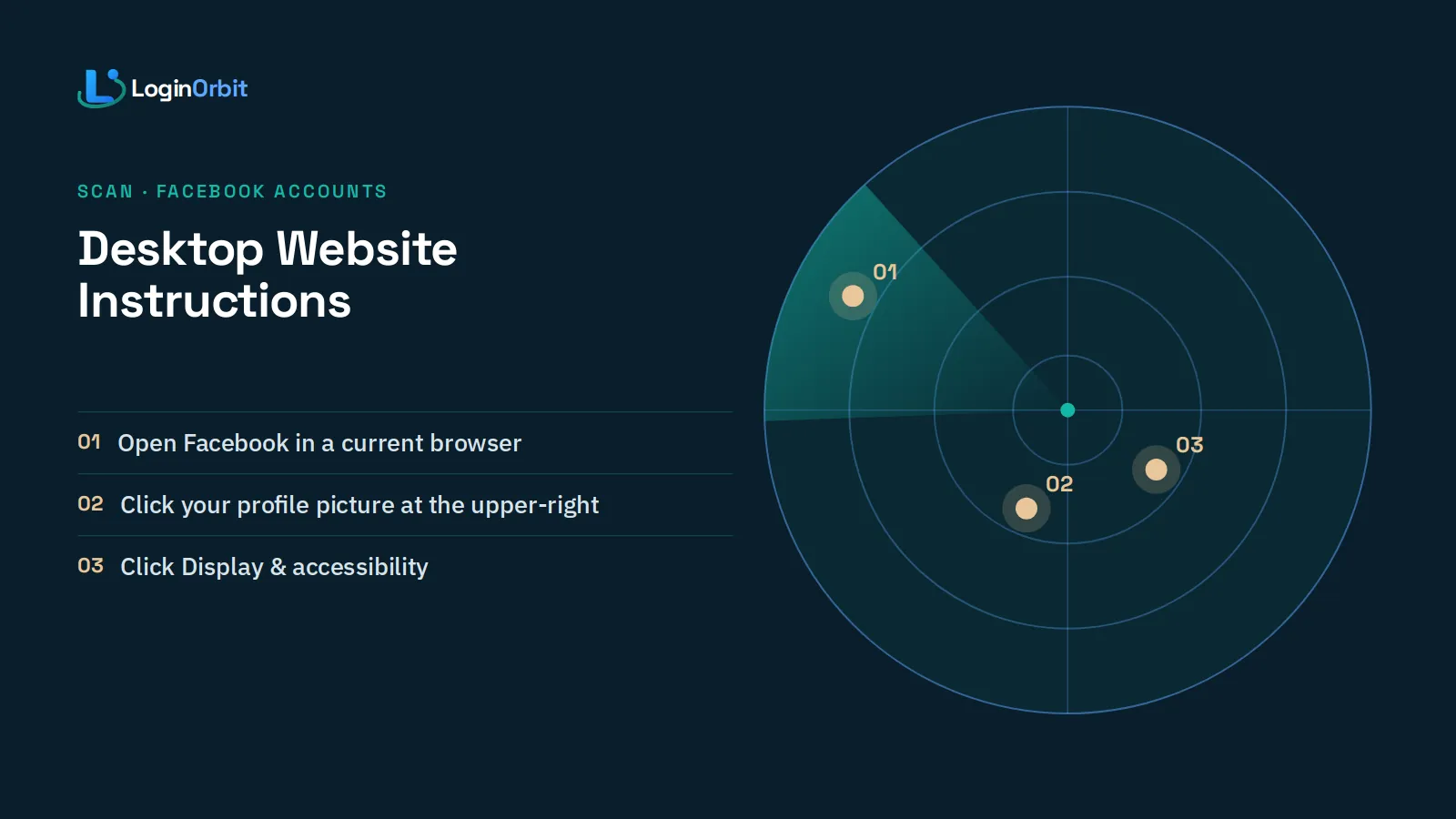
- Open Facebook in a current browser.
- Click your profile picture at the upper-right.
- Click Display & accessibility.
- Locate Dark mode.
- Choose On, Off, or Automatic, if that option is shown.
The label may be Dark mode, Appearance, or Display & accessibility. Facebook can also place the profile menu on the left or right side depending on window width, browser zoom, and its current layout.
Facebook in a work browser
A company-managed browser can prevent settings from being saved, clear cookies when the window closes, or apply a forced color scheme. Test Facebook in a regular personal browser window if the dark setting keeps resetting.
| Situation | Likely reason | What to try |
|---|---|---|
| Setting disappears after closing browser | Cookies or site data are cleared | Allow Facebook site data |
| Facebook stays light | Dark mode was set to Off | Select On again |
| Menus are hard to read | Browser extension conflict | Disable color-changing extensions |
| Only one account changes | Preference is account-specific | Repeat steps for each account |
| Page looks partly dark | Cached or mixed interface | Refresh, sign out, and sign in |
Browser extensions
Extensions such as Dark Reader and similar color tools can alter Facebook independently of Facebook’s built-in setting. Running both systems at once may produce strange colors, inverted images, unreadable text, or dark pop-up windows.
- Dark Reader can apply a browser-level theme.
- High-contrast extensions can override background colors.
- Ad-blocking extensions can occasionally hide interface elements.
- Custom user-style tools can change Facebook’s menus or buttons.
If Facebook’s own dark mode looks wrong, temporarily disable these tools and reload the page.
Choose Automatic Dark Mode
Facebook may offer System or Automatic rather than a separate schedule. This setting follows the appearance preference of your operating system.
On an iPhone, open Settings, select Display & Brightness, and choose Light or Dark. On Android, open Settings and look under Display, Wallpaper and style, or a similar category. Windows and macOS also provide system-wide appearance controls, although the exact labels depend on the version.
How automatic mode behaves
- System follows the device’s current light or dark appearance.
- On ignores the device and keeps Facebook dark.
- Off ignores the device and keeps Facebook light.
- A phone’s sunset schedule can change Facebook when System is selected.
- A computer’s automatic appearance schedule can do the same.
| Facebook choice | Device appearance | Facebook result |
|---|---|---|
| System | Light | Light Facebook interface |
| System | Dark | Dark Facebook interface |
| On | Light or dark | Dark Facebook interface |
| Off | Light or dark | Light Facebook interface |
Automatic behavior is useful if you read Facebook in bright daytime and low-light conditions at night. It also avoids changing the setting manually whenever the sun goes down.
Warning: System mode doesn’t mean every Facebook post becomes dark. Photos, videos, games, shopping pages, and websites opened from Facebook keep their own colors and settings.
What Dark Mode Changes
Dark mode changes Facebook’s interface palette. It usually replaces bright white backgrounds with dark gray or near-black surfaces and changes text, icons, menus, and selected controls to maintain contrast.
It normally affects:
- The News Feed background.
- Comment areas and reply boxes.
- Profile pages and Facebook Groups.
- Notifications and messages.
- Settings screens.
- The navigation menu.
- Search pages.
- Reels and video controls around the content.
It may not affect:
- A user’s uploaded photograph.
- A shared video’s own brightness.
- Advertisements designed with light backgrounds.
- A linked article opened in another app.
- Embedded content supplied by another service.
- Images containing white text or bright graphics.
Dark mode is an interface preference, not a universal filter. If a specific post is painfully bright, lower the device brightness, use a system accessibility filter where appropriate, or open the content in an app that offers its own dark theme.
Dark mode and readability
A dark background can feel more comfortable in a dim room because it reduces the amount of bright light emitted by the interface. However, readability depends on font size, contrast, glare, screen quality, and personal vision needs.
If text looks faint, try:
- Increasing display text size.
- Turning off a browser’s forced color mode.
- Disabling an overly strong screen filter.
- Raising brightness slightly rather than staring at a very dim screen.
- Using Facebook’s standard light theme for long reading sessions.
Does It Save Battery?
Dark mode may save energy on phones with OLED or AMOLED displays because those screens can use less power to show truly dark pixels. The result isn’t guaranteed and varies with screen technology, brightness, app behavior, and how much time you spend looking at dark areas.
On LCD screens, the backlight generally remains on behind the display, so changing Facebook’s colors may provide little or no battery improvement. On OLED screens, savings are more plausible when the interface is genuinely black or very dark, but Facebook content can still include bright images and videos.
Battery impact depends on:
- Screen technology, such as OLED, AMOLED, or LCD.
- Brightness level, which often matters more than theme choice.
- Content mix, including photos, videos, and advertisements.
- Time spent, because a theme can’t save energy when the screen is off.
- App activity, such as video playback and background loading.
Dark mode is best chosen for comfort and preference rather than as a guaranteed battery-saving solution. If battery life is your priority, also reduce unnecessary brightness, limit video autoplay, and review background activity on your device.
Why Is Dark Mode Missing?
The most common reason is that Facebook has changed the menu location or is showing a different interface to your account. A missing option doesn’t necessarily mean your phone is incompatible.
Common causes
- Outdated app: An old release may use a different settings structure.
- Temporary bug: A failed update or corrupted cache can hide preferences.
- Facebook Lite: The lighter app may not include every feature.
- Browser layout: The mobile website may expose fewer controls.
- Managed device: Work or school settings can restrict appearance changes.
- Account rollout: Facebook may deliver interface changes gradually.
- Wrong menu: The option may be under Display & accessibility rather than Settings.
- Temporary service issue: A Facebook-side error can affect menus.
Quick fixes
Try these in order:
- Close Facebook completely and reopen it.
- Update Facebook through the Apple App Store or Google Play.
- Restart the phone or tablet.
- Sign out, then sign back in.
- Search Settings & privacy for dark mode.
- Clear the Facebook app cache on Android.
- Reinstall the app if the setting remains absent.
- Try the desktop website or a different current browser.
On iPhone and iPad, there’s no general “clear app cache” button for every app. Reinstalling Facebook is the usual way to refresh its stored application data, but make sure you know your login details first.
Fix Dark Mode Problems
Sometimes dark mode is technically enabled but the screen still looks partly light, flickers, or changes back after an update. Use the symptom that most closely matches what you see.
Facebook keeps switching back
Check whether the setting is on System rather than On. If your phone changes between light and dark automatically, Facebook will follow that schedule. Browser cleanup tools can also remove the preference or sign you out.
Try:
- Select On instead of System.
- Turn off automatic device appearance temporarily.
- Allow Facebook cookies in your browser.
- Avoid private browsing for persistent settings.
- Update Facebook after saving the preference.
Some pages remain bright
This is usually normal. Facebook can’t control the color scheme of every image, advertisement, video player, or external webpage. A post may also contain a white graphic that remains bright against the dark feed.
Try:
- Lowering brightness while viewing the post.
- Opening the linked page and enabling its own dark mode.
- Using a device accessibility feature for extreme brightness.
- Returning to the feed if only one embedded player looks wrong.
Text or icons are hard to see
An extension, custom browser theme, or device contrast setting may be conflicting with Facebook. Turn off third-party color tools, reload the page, and check whether text becomes readable.
If the problem persists, try a different browser without extensions. On a phone, compare the Facebook app with the mobile website. If only one version has the problem, report it through Facebook’s help and feedback tools.
Dark mode won’t stay on
Facebook may store different preferences for different logged-in accounts or devices. The desktop website and mobile app can also behave differently after a redesign.
- Confirm the correct Facebook account.
- Save the setting while connected to a reliable network.
- Update both Facebook and your browser.
- Test without a VPN or content-filtering extension.
- Check whether the device automatically clears app data.
Warning: Avoid unofficial “Facebook dark mode” downloads that ask for your password. Facebook’s built-in setting doesn’t require a separate theme app, browser plug-in, or login outside Facebook.
Dark Mode and Messenger
Facebook’s main app and Messenger can have separate appearance settings. Turning on Facebook dark mode may not change every Messenger screen, especially if you use the standalone Messenger app.
Messenger app
Open Messenger, tap your profile picture or menu button, and look for Dark mode or Appearance. Choose On or System. The exact path can change between iPhone, Android, and Messenger releases.
Messenger website
Facebook's Help Center says dark mode is not currently available on messenger.com. Chat-specific themes can still change the look of individual conversations.
Messenger also supports conversation themes and colors. Those themes change the appearance of a particular chat and shouldn’t be confused with the global dark interface.
| Product | Setting to check | May be separate? |
|---|---|---|
| Facebook app | Dark mode in Settings | Usually applies to Facebook |
| Facebook website | Display & accessibility | Applies to the website session |
| Messenger app | Appearance or Dark mode | Yes |
| Messenger website | Not available on messenger.com; chat themes only | Sometimes |
| Facebook Lite | Menu and appearance settings | Feature availability varies |
Privacy and Safety Notes
Changing Facebook’s display theme doesn’t change who can see your posts, profile, messages, activity, or advertising preferences. Dark mode is a visual setting, not a privacy control.
Don’t confuse these settings:
- Dark mode: Changes interface colors.
- Privacy settings: Control audience and account visibility.
- Active status: Controls whether others can see when you’re online.
- Notification settings: Control alerts and sounds.
- Data usage: Controls media loading and network behavior.
- Accessibility settings: Change text, contrast, motion, or screen behavior.
Use Facebook’s own app settings rather than a third-party tool that requests account credentials. Legitimate dark mode instructions shouldn’t require your password, security code, or recovery email outside the official Facebook sign-in process.
For additional help, Facebook’s official instructions are available in its Dark Mode Help Center.
Related guides
- How scammers hack Facebook accounts
- How to Set Up a Facebook Account the Right Way
- How to Recover a Hacked Facebook Account Safely
Short on time? Our Facebook Account Setup & Security Service service takes care of the whole process.
Frequently Asked Questions
How do I turn on dark mode on Facebook?
Open Facebook’s Menu, choose Settings & privacy, open Settings if necessary, and select Dark mode. Choose On for a permanent dark interface or System to follow your phone or computer’s appearance setting. On desktop, click your profile picture, select Display & accessibility, and choose Dark mode.
Why can’t I find dark mode on Facebook?
Facebook may have moved the option, changed the menu design, or be showing a different version to your account. Update the app, restart it, and look under Settings & privacy, Preferences, Display, or Display & accessibility. You can also try the desktop website or a current mobile browser.
Does Facebook dark mode save battery?
It can save some energy on OLED or AMOLED screens, particularly at lower brightness, but the amount varies. LCD screens may show little benefit because their backlight remains active. Bright photos, videos, ads, and other content also reduce any potential savings.
Can Facebook dark mode turn on automatically?
Yes, if Facebook offers System or Automatic and you select it. Facebook will follow your device’s light and dark appearance schedule. If the option is missing, choose On manually or set dark appearance on your phone or computer and check Facebook again.
Why are some Facebook posts still white?
Dark mode changes Facebook’s interface, not the colors inside every post. Photos, videos, advertisements, shared graphics, and external webpages keep their own designs. Lower your screen brightness or use the content’s own dark setting if a particular page remains uncomfortable.
Is Facebook dark mode available on every device?
It’s available on many current versions of Facebook for iPhone, iPad, Android, and desktop browsers, but feature availability can vary. Facebook Lite, older app releases, unsupported browsers, and managed devices may show fewer appearance controls.
What to do next
Open Facebook’s menu now and check Settings & privacy for Dark mode. If you want the interface to change with your phone, select System; if you want a consistent appearance, select On. Update the app first if neither option appears, then retry the desktop website as a practical backup.