You can change your Facebook name from Settings & privacy by opening Accounts Center, selecting your Facebook profile, and editing the name fields. Facebook may ask you to review the change or confirm your password, and you generally can’t change your name again for 60 days, so check the spelling and format before saving.
Key Takeaways
- Use Accounts Center on the Facebook website or mobile app to edit your profile name.
- Enter the name people know you by; avoid symbols, unusual capitalization, titles, slogans, and fake names.
- Facebook may require identity verification if the change looks unusual or conflicts with its naming rules.
- Your profile name is different from your username, nickname, Page name, and professional-mode display information.
- If the option is missing, check for a recent name change, an account restriction, an unfinished review, or an app problem.
- Save a screenshot of your current name before changing it, especially if your account supports work, school, or business contacts.
Change Your Name on Facebook
The process is similar on a computer, iPhone, Android phone, and mobile browser, although button names and menu locations can vary slightly by app version. Facebook has been moving personal-account settings into Meta’s Accounts Center, so an older guide may tell you to use a “Name” page that no longer appears in the same place.
On a computer
- Sign in to the Facebook account whose name you want to change.
- Select your profile picture in the upper-right corner.
- Choose Settings & privacy, then select Settings.
- Open Accounts Center. It may appear near the top of the settings page.
- Select Profiles, then choose your Facebook profile.
- Select Name.
- Edit your first name, middle name, or last name.
- Choose Review change.
- Select the display order you want.
- Enter your Facebook password if prompted.
- Select Save changes.
The display-order choice controls whether Facebook shows your given name first or your family name first. It doesn’t create a separate legal-name field. If your culture or family naming convention doesn’t fit the available order, use the closest accurate option and consider adding additional information in your About section.
On the Facebook app
- Open the Facebook app and tap the Menu button.
- Tap the Settings gear.
- Choose See more in Accounts Center, if shown.
- Tap Profiles, then select the Facebook account.
- Tap Name.
- Enter the new information.
- Tap Review change.
- Pick the preferred name order.
- Type your password if Facebook requests it.
- Tap Save changes.
If you don’t see Accounts Center, look under Personal and account information, Personal details, or a similar settings category. Facebook tests different layouts, and Android and iOS may not show identical wording.
Quick path comparison
| Device | Starting menu | Name setting | Final action |
|---|---|---|---|
| Desktop browser | Profile picture → Settings & privacy | Accounts Center → Profiles → Name | Review and save |
| iPhone app | Menu → Settings | Accounts Center → Profiles → Name | Review and save |
| Android app | Menu → Settings | Accounts Center → Profiles → Name | Review and save |
| Mobile browser | Menu → Settings | Accounts Center or Personal details | Review and save |
Pro Tip: If the app loops back to the settings screen, try Facebook in a current desktop browser. A browser often exposes the full Accounts Center path even when the app’s menu is incomplete.
What Name Can You Use?
Facebook expects a personal profile to use the name you go by in everyday life. That doesn’t necessarily mean the exact name printed on a birth certificate. A married name, shortened first name, culturally customary name, or established professional name may be acceptable, provided it represents a real identity rather than an advertisement or invented persona.
Facebook may reject names containing:
- Numbers such as “Jordan123”
- Repeated punctuation or decorative symbols
- Unusual capitalization such as “jOrDaN”
- Titles such as “Dr.”, “Rev.”, or “Captain”
- Slogans such as “Best Realtor in Dallas”
- Job descriptions such as “Maria Customer Support”
- Multiple unrelated words
- Offensive or impersonating terms
- Characters that don’t represent your actual name
Name-format examples
| Situation | Usually appropriate | Usually unsuitable |
|---|---|---|
| Marriage | “Taylor Morgan” after marriage | “Taylor Morgan Official” |
| Nickname | “Alex” if people know you by it | “Alex the Great” |
| Professional identity | A genuine name used publicly | “Chris Best Plumber” |
| Cultural naming | Your customary real-world format | Random symbols between names |
| Privacy preference | A legitimate shortened name | A fake identity used to mislead |
| Middle name | A real middle name | A slogan in the middle-name field |
You may be able to add a nickname, maiden name, alternate spelling, or professional name separately. That information can appear beside your main name, in search results, or in the About section depending on your privacy settings. It doesn’t necessarily replace the primary profile name.
Warning: Don’t use a fake name simply to bypass a restriction. Facebook can limit or suspend an account that appears deceptive, impersonating, automated, or connected to abusive activity. A legitimate name change is safer than repeatedly submitting random variations.
Before You Save the Change
A name update can affect how friends, coworkers, customers, and old contacts recognize you. Spend a minute checking the practical consequences before selecting Save changes.
Check these details
- Spelling: Confirm accents, hyphens, apostrophes, and capitalization.
- Order: Make sure the given-name and family-name fields aren’t reversed.
- Recognition: Decide whether people will identify you under the new name.
- Messages: Existing Messenger conversations may continue showing the updated profile name.
- Tags: Older posts and photographs can still contain tags to your profile.
- Search: Friends may find you by your new name, but search visibility also depends on privacy settings.
- Business use: A personal profile name isn’t a substitute for a Facebook Page name.
- Verification: Prepare an acceptable identity document only if Facebook specifically requests one.
Changing your profile name doesn’t automatically change your username. Your username is the text in your profile URL, such as the part after facebook.com/. It may have separate availability rules and may remain unchanged after a name edit.
It also doesn’t change names on other services linked through Accounts Center. Instagram, Threads, or another Meta account may have separate profile-name settings, even though the accounts are connected.
Name versus related identity fields
| Facebook item | What it controls | Changed by the name tool? |
|---|---|---|
| Profile name | The main name shown on your personal profile | Yes |
| Username | Your profile URL and @-style identifier | No |
| Nickname | An additional name attached to your profile | No |
| Facebook Page name | The name of a business, organization, or public project | No |
| Messenger nickname | A name used in a particular chat | No |
| Profile pronouns | Pronouns displayed on your profile | No |
How Often Can You Change It?
Facebook commonly limits a personal profile to one name change within a 60-day period. The exact restriction can depend on your account history, the type of change, and whether Facebook asks for a review. The waiting period isn’t a setting you can shorten through the app.
If you changed your name recently, the Name screen may show the current name without an editable option, or it may display a message explaining that you must wait. Reinstalling the app, switching devices, or changing your password won’t normally remove that restriction.
Typical timing situations
| Situation | What you may see | Best next step |
|---|---|---|
| First change in a long time | Edit fields and Review change | Verify carefully and save |
| Change made recently | A waiting message | Wait until the restriction ends |
| Name under review | Pending or limited controls | Follow the review instructions |
| Rejected name | Error or policy notice | Use a compliant real-world format |
| Locked account | Broader account warning | Secure and recover the account first |
Avoid making several small edits in a row. “Sam Lee,” “Samuel Lee,” and “Samuel J. Lee” can look like repeated attempts to evade a limit, even if each version is genuine. Decide which accurate version you want before submitting the request.
Pro Tip: Record the date of your last successful change in a password manager or private note. That makes the 60-day window easier to track and prevents unnecessary support requests.
Why Is the Name Option Missing?
A missing Name option doesn’t always mean your account is permanently blocked. Facebook can hide or limit settings when it detects a security issue, an account restriction, a recent change, or a pending identity review.
Common causes include:
- A recent change is still inside the waiting period.
- Your account has an unresolved security check.
- Facebook has placed a temporary feature restriction on the account.
- Your profile is under identity or authenticity review.
- You’re using a Page, not a personal profile.
- The app is outdated or displaying an incomplete menu.
- You’re signed into the wrong Facebook account.
- A browser extension or cached session is interfering.
- Your account is managed through an organization or unusual login setup.
- The requested name has already triggered a policy warning.
First confirm that you’re editing the correct profile. Open your profile picture menu and compare the profile photo, email address, and account name. If you manage several Pages or connected accounts, it’s easy to open settings for the wrong identity.
Next, check Account Status or Support Inbox for a message about restrictions. Read the specific notice rather than submitting the same name repeatedly. A restriction can involve security, spam, impersonation, unusual login activity, or another policy issue.
Fix Errors and Rejections
A name request can fail for several different reasons. The error message matters: a temporary technical failure needs different treatment from a rejected name or an identity request.
If Facebook rejects the format
Try a plain version of your actual name:
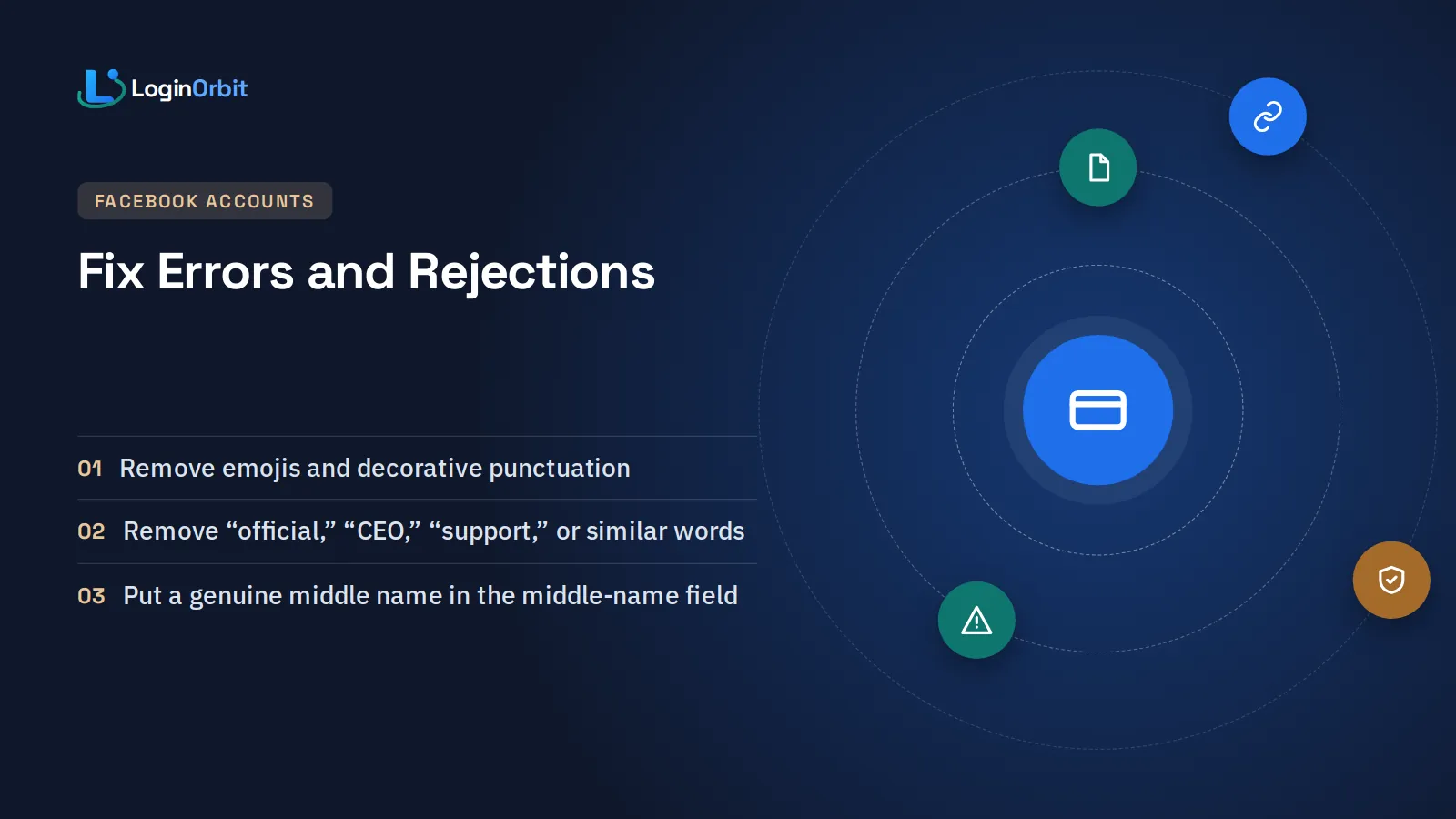
- Remove emojis and decorative punctuation.
- Remove “official,” “CEO,” “support,” or similar words.
- Put a genuine middle name in the middle-name field.
- Use standard capitalization.
- Remove phone numbers, locations, and business slogans.
- Check that the name doesn’t impersonate a public figure or organization.
Don’t add a title to the first-name field. If a title is important to your identity or work, place it in your bio, About section, or professional information instead.
If Facebook asks for proof
Follow the specific on-screen instructions and submit only through Facebook’s own review flow. The requested document may need to show your name and may allow you to cover information that isn’t necessary for the review. Don’t send identity documents to strangers who contact you by email, Messenger, or comments.
If the app fails
Try these concrete fixes:
- Update Facebook through the Apple App Store or Google Play.
- Force-close and reopen the app.
- Clear the Android app cache.
- Sign out, then sign back in.
- Try a private browser window.
- Disable a browser extension that blocks scripts.
- Switch between Wi-Fi and mobile data.
- Try the desktop website.
- Check whether Facebook is experiencing a wider outage.
Warning: Never pay a third party that promises to unlock the name field. Legitimate support doesn’t require you to hand over your password, one-time security code, or complete identity document through an unofficial account.
Change a Facebook Page Name
A Facebook Page is separate from a personal profile. Page names can represent businesses, organizations, artists, brands, public figures, or projects, and you need the proper Page access to edit one.
A typical Page path is:
- Switch into the Page or open the Page you manage.
- Select the Page profile picture or Settings.
- Open Page setup, Page information, or a similarly named section.
- Select Name.
- Enter the proposed Page name.
- Review the change and submit it.
Only people with suitable Facebook access or task permissions may see the edit control. A Page name should accurately describe the Page and shouldn’t use excessive punctuation, misleading terms, unauthorized trademarks, or a string of promotional claims.
Profile and Page comparison
| Item | Personal profile | Facebook Page |
|---|---|---|
| Represents | An individual person | A business, group, brand, or public presence |
| Access | Controlled by the account holder | Managed by people with Page access |
| Name limit | Often restricted after a recent change | Reviewed under Page naming rules |
| Username | Personal profile URL | Page URL and handle |
| Best for | Personal connections | Public or organizational communication |
Changing a personal profile name won’t rename a Page you administer. Change the Page separately, and make sure you have selected the correct identity before saving.
Change Your Username Too
Many people search for a name change when they actually want a different profile link. Your username is the identifier used in your Facebook URL and may also appear as an @ handle. Changing it can affect links printed on business cards, websites, email signatures, and messages.
To look for the username setting:
- Open Settings & privacy.
- Go to Settings and then Accounts Center, if Facebook places the control there.
- Choose the relevant profile.
- Look for Username or the profile-link setting.
- Enter an available username and review the resulting URL.
- Save the change.
A username usually must be available and may have length, character, or authenticity restrictions. Don’t assume that changing your visible name will free or update the old username. Test important links after changing it, and update links you control.
If the username is unavailable, try a modest variation based on your real name or organization. Avoid adding a long sequence of numbers that makes the account look automated or unrelated.
Protect Your Account During Changes
A name change is a good time to review account security, particularly if you changed your name because of marriage, divorce, harassment, a move, or a change in public role.
Take these actions:
- Turn on two-factor authentication.
- Review active sessions and sign out unfamiliar devices.
- Confirm your recovery email and phone number.
- Check recent login alerts.
- Review who can find you by email or phone.
- Limit old posts if the new name is intended to improve privacy.
- Remove outdated workplace or location details.
- Check tagged photos and public comments.
- Tell close contacts how they will recognize the account.
A name change alone doesn’t hide old content. A public post remains public unless you change its audience or remove it. Likewise, changing the profile name doesn’t erase search-engine results, copied screenshots, comments, or messages already sent.
For a safety-related change, consider whether your profile photo, username, employer, school, and public friends list could still identify you. Privacy adjustments may be as important as the new name itself.
Related guides
Want an expert to set this up with you? Take a look at Facebook Account Setup & Security Service.
Frequently Asked Questions
Can I change my Facebook name before 60 days?
Usually not through the ordinary name editor. Facebook commonly applies a 60-day restriction after a name change. If the change is necessary because of marriage, divorce, legal correction, or another genuine circumstance, check the review or identity-verification option Facebook provides instead of repeatedly submitting edits.
Why does Facebook say my name isn’t allowed?
The name may contain a title, slogan, number, unusual punctuation, excessive capitalization, or words that don’t appear to represent a person. Remove those elements and submit a straightforward version of your real name. If Facebook still rejects it, use the on-screen review process and provide documentation only when requested.
Will my friends be notified when I change my name?
Facebook may show the updated name wherever your profile appears, but it doesn’t necessarily send every friend a dedicated notification. People can notice it in their feed, Messenger conversations, comments, tags, or friend lists. Privacy settings affect who can see your profile and posts, not just the name field.
Can I use a nickname on Facebook?
You may be able to add a nickname or alternate name separately from your primary profile name. A nickname is more suitable when people genuinely know you by it. Don’t use a nickname field for advertising, insults, impersonation, or a collection of unrelated keywords, because Facebook may still restrict the profile.
How do I change my name on Facebook without a password?
You generally need access to the account, and Facebook may ask for the password as a security check. If you forgot it, use Facebook’s official account-recovery flow first. Don’t give your password or recovery code to anyone claiming they can change the name for you.
What to do next
Changing your name is usually a short Accounts Center task, but the safest approach is to choose the final, recognizable version before submitting it. Open Facebook on a desktop browser if the app hides the setting, check Account Status for restrictions, and use the official review process if Facebook asks you to verify your identity.