Facebook’s share button is usually missing because the page or post’s sharing setting, template, or Facebook integration blocks it. The fastest check is to open the same content in a private browser window and view it while logged out. If the button appears there, your account or browser is the problem. If it’s missing for everyone, check the page editor, social-sharing plugin, or Facebook settings. The answer to a missing Facebook share button, including its causes and fixes, is usually found by comparing the button on one working page with the page that fails.
Why the Facebook share button is missing
The cause is usually local to the page, post, browser, or website setup. Start with the most common checks before changing code or reconnecting an account.
| Cause | How common | How to confirm it | Fix it yourself? |
|---|---|---|---|
| Sharing setting blocks button | Very common | Check post privacy menu | Yes |
| Social plugin is disabled | Very common | Open plugin settings | Yes |
| Button hidden by page template | Common | Compare another page | Yes with care |
| Browser cache or extension | Common | Test private window | Yes |
| Facebook integration changed | Less common | Check plugin notices | Yes with care |
| JavaScript error stops loading | Less common | Check browser console | Yes with care |
| Account or platform restriction | Rare | Test another account | No |
The order matters because a privacy setting can look like a broken button. If the button is present on other pages but missing on one post, inspect that post first. If it’s absent across the whole site, inspect the sharing tool or website template.
Private or restricted posts hide sharing
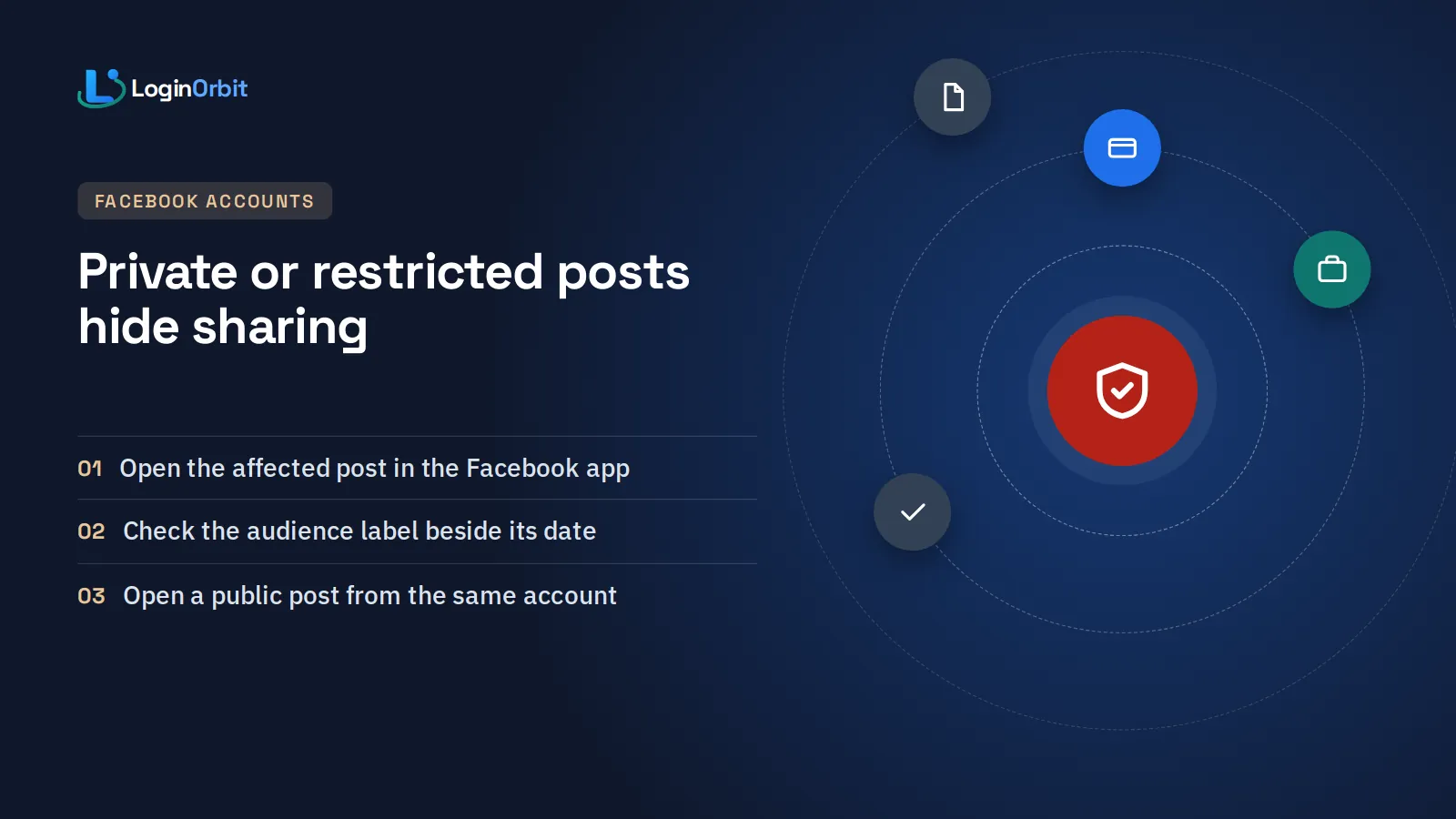
A restricted audience is the most likely reason a Facebook share option disappears from a post. Facebook can limit who may see a post, and the available sharing choices can change with that audience. A post shared with a limited group, for example, may not offer the same public sharing path as a post set to a wider audience.
Open the post in Facebook, then select the audience icon beside the date or privacy label. Read the current choice instead of guessing from the post’s text. If the post is limited to a custom group, friends, or another restricted audience, change it only if you’re comfortable letting a wider audience see it.
To confirm the cause, compare three things:
- Open the affected post in the Facebook app.
- Check the audience label beside its date.
- Open a public post from the same account.
- Compare the menus and available share choices.
- Ask a trusted person outside the original audience to view the post.
If the public post has a share choice but the restricted post doesn’t, the audience setting is the clear difference.
The fix is to edit the post’s audience and choose a broader option, such as Public, when that’s suitable. Facebook may not let you make every old post public, and changing privacy doesn’t remove the original post or rewrite every past share. Check the audience again after saving, then refresh the page.
This change takes only a few minutes when the post is editable. It may take longer if you’re working inside a Page, group, event, or business account with separate permissions. If the audience control is missing, don’t try to bypass it with code; ask the account owner or administrator.
A common mistake is testing with your own account only. Your account may have permission to see content that other visitors can’t, so you can waste time repairing a button that’s actually hidden by privacy rules.
If the post is public but sharing is still unavailable, move to the website or integration checks below. If the post is in a group, the group’s rules and membership can matter more than the post’s individual setting.
A broken sharing plugin removes the button
A disabled, outdated, or badly configured social-sharing plugin can remove Facebook buttons from every page on a website. This cause differs from a privacy problem because the button disappears across several public pages, including pages that visitors can open without signing in.
First, check whether the button is missing from one page or the whole site. Open a recent article, an older article, and a standard page in a private window. If all three lack the button, sign in to the website’s administrator area and open the social-sharing tool’s settings.
Look for these controls:
- Facebook sharing enabled
- Button display on posts
- Button display on pages
- Mobile display enabled
- Correct placement selected
- Changes saved and published
The exact names depend on the website platform and plugin. Read the plugin’s documentation before switching settings that mention API keys, access tokens, scripts, or permissions. Those controls can affect more than the visible button.
After saving a change, clear the site cache and test the public page again. If the website uses a content delivery network, its cached copy may continue showing the old version until it refreshes. Don’t repeatedly change settings while the result is still cached; that makes it harder to know which change worked.
If the plugin was recently updated, check its update notes and the website’s error log. A new version can change where buttons appear or stop working with an older theme. If the plugin is no longer maintained, replacing it may be safer than adding random code snippets.
The time needed ranges from a quick setting change to a longer compatibility check. The money cost can be low when you can use the existing tool, but a paid plugin or developer may be needed if the theme and plugin conflict.
If every page is missing the button, check the plugin’s global display rules; if only one page is affected, inspect that page’s individual sharing setting. That simple split prevents a site-wide change from creating a second problem.
The page template hides the button
A page template can hide a Facebook button even when the sharing tool works correctly. This happens when the affected page uses a different layout, custom post type, landing-page template, or mobile-only design.
Compare the affected page with a working page in the same browser. Check whether both pages use the same template, content type, and button location. If the working page shows buttons below the article but the affected page uses a full-width landing layout, the layout difference is a stronger clue than the Facebook account.
The safest test is to create a temporary draft using the same template as the working page. Add a short piece of test content, enable the sharing option, and preview it while logged out. Don’t publish private information just to test a button.
If the button appears in the standard template but not the custom one, open the template settings and look for social-sharing blocks, reusable sections, or visibility rules. A block may be disabled on mobile, hidden for a specific post type, or placed behind a consent banner.
Some website builders also let each page override global settings. Check the page’s own sidebar or document settings for options such as “hide sharing,” “disable social buttons,” or “exclude from social tools.” The wording varies by platform, so use the platform’s documentation rather than guessing.
The fix may be simple: add the sharing block, remove the exclusion, or select the normal article template. If the template contains custom code, ask the theme developer or a qualified web developer to inspect it. Avoid deleting template files or pasting code from an unknown source.
A useful trade-off is control versus maintenance. A custom template gives you more design control, but every theme change can break its social block. A standard template is less flexible, yet it’s usually easier to update and support.
Browser settings stop the button loading
A browser problem can make the button look missing even when the website is configured correctly. Cached files, content blockers, strict privacy extensions, or disabled scripts can stop the social-sharing element from appearing.
Test the page in a private window first. If the button appears there, temporarily disable browser extensions one at a time in your normal window. Start with ad blockers, script blockers, privacy tools, and security extensions because they can block social scripts or embedded content.
Next, test a second browser on the same device. Then test the page on a phone using mobile data rather than the same Wi-Fi network. If the button works in another browser and on another network, the website may be fine.
Clear the cache for the affected site, not necessarily the entire browser. Sign in again only if the page requires an account. If clearing cookies removes saved preferences, you may need to reset those choices before testing.
A browser console error can help, but it isn’t a good place to guess. You can safely read the console for repeated red error messages, then record the page address, browser name, and error text. Don’t paste unknown commands into the console; a malicious command can expose account data or change a session.
If the button appears only after scripts are allowed, keep the extension enabled on other sites and allow scripts only for the trusted site when the extension supports that choice. If the button fails in every browser and on several networks, return to the plugin, template, and account checks.
Less common Facebook button problems
- Facebook changes the sharing flow: A platform update may move sharing into a menu rather than show a separate button; check whether a three-dot menu offers Share.
- Consent software blocks social scripts: A cookie or privacy banner may prevent the button until the visitor accepts the relevant category; the clue is that it appears after consent.
- A business account lacks permission: A Page or business tool may hide controls from people without the needed role; ask the administrator to test it.
- The post or domain is restricted: A security or policy action may limit sharing; the clue is a warning, missing preview, or account notice.
- The site has a JavaScript conflict: The clue is that several interactive elements fail together, not just Facebook.
Stop DIY work when the next step involves account recovery, policy appeals, server files, payment access, or code that could expose visitor data. A site administrator, the plugin maker, or Meta support should handle that part.
What fixing the Facebook button usually takes
A privacy fix usually takes only a short account-setting change. Its cost is low because you don’t need a new tool, but the trade-off is that a wider audience may see the post. If that exposure isn’t acceptable, keep the restricted audience and use another approved way to share the information.
A plugin fix needs administrator access, the plugin documentation, and a cache refresh. It’s often smaller than rebuilding a page, but an abandoned plugin can turn a quick setting change into a replacement project. Record the current settings before changing them so you can undo the change.
A template fix may need a page builder, theme access, or a developer. It can be more costly than a browser fix because the change may affect every page using that template. Ask for a quote based on the exact template, page type, and number of affected layouts.
A browser fix needs no paid part, but it may require testing extensions, cookies, browsers, and networks. If the button works only after accepting a consent choice, review the site’s privacy setup instead of telling visitors to weaken their browser security.
This isn’t for someone who only needs to share one post and doesn’t control the account or website. In that case, copy the page link and use Facebook’s normal post composer, if the owner permits it. For a real quote, give the technician the affected URL, one working URL, screenshots, browser details, and the time the problem began.
Related guides
- How scammers hack Facebook accounts
- How to Set Up a Facebook Account the Right Way
- How to Recover a Hacked Facebook Account Safely
Short on time? Our Facebook Account Setup & Security Service service takes care of the whole process.
Frequently asked questions
Can I share a Facebook post without the share button?
Yes, you can often copy the post link and paste it into a new Facebook post, but the result still follows the original post’s audience rules. A private or restricted post may not be visible to the people who receive the link. If copying the link produces an error or warning, the account, group, Page, or domain may have a restriction that only an administrator or Meta can resolve.
Why is the share button missing on Facebook but not on my website?
The website button and Facebook’s own post menu are separate features. A website plugin or template can fail while Facebook sharing works normally, or Facebook can limit a post while the website still displays its button. Test both sides separately: open the post in Facebook, then open the website in a private window. The side that fails tells you where to continue checking.
How long does it take to fix a missing Facebook share button?
A privacy or browser fix can take 5–15 minutes when you have access to the account and the setting is clear. A plugin or template problem can take from one short edit to several hours, depending on caching and code conflicts. The page’s platform, template, and number of affected pages decide the real time, so a developer needs those details before quoting.
Is it safe to add Facebook sharing code to my website?
It can be safe when the code comes from the platform or a trusted plugin and your site is backed up first. Random snippets can create security, privacy, or performance problems, especially when they load third-party scripts. If the change involves server files, visitor data, login tokens, or payment pages, stop and ask your site administrator or a qualified developer to review it.
What happens if I change a Facebook post from private to public?
The post can become visible to a much wider audience, and people may be able to share it through Facebook’s available sharing options. That change doesn’t mean every past share becomes public, and it doesn’t remove copies someone already made. Check the audience label after saving, and change it only when the post contains no information that should remain limited.
Does it matter if the button is missing only on mobile?
Yes, because mobile and desktop can use different templates, scripts, or display rules. First test the same page in a private mobile browser and on desktop. If only mobile fails, inspect the mobile layout, responsive visibility settings, and consent banner. If both fail, focus on the page audience, social plugin, or account restriction instead of changing mobile code alone.
What to do next
Keep the comparison page handy and test the sharing button after each change. If it still doesn’t appear, contact your website host or Facebook Support with the page link, device, and browser details. They can spot permission, template, or platform issues you may not be able to see from your own account.