People who search for ways to buy Facebook accounts usually want one thing: a profile that can do outreach without getting blocked. Aged accounts with friends, Marketplace access and years of history look like the perfect tool for joining groups, sending DMs and collecting leads. In practice, a bought account is one of the fastest ways to lose access, money and leads. This guide explains why aged accounts fail, what Meta actually looks at, and the safer ways to get the same results with a profile you own.
Why people want to buy aged Facebook accounts
The demand is real, and so are the problems behind it. Most buyers want an aged or old Facebook account for one of these reasons:
- Outreach and lead collection: messaging potential clients and building a list of leads from groups and comments.
- Joining many groups: new profiles often hit limits or get reviewed when they join groups quickly.
- Sending DMs at scale: new accounts that message many strangers get warnings or blocks.
- Marketplace selling: some new profiles don’t get Marketplace access, or lose it after a few listings.
- Running ads after a restriction: the buyer’s own profile was restricted and they want a way back in.
Sellers promise that an older account, with friends and history, is “trusted” by Facebook and won’t be blocked. That promise is where the trouble starts.
What sellers actually offer
Listings for aged Facebook accounts tend to look alike. You’ll see creation years, friend counts, “Marketplace enabled”, “verified with email and phone” and “instant delivery”. What the listings rarely tell you is where the accounts came from or who still controls them.
- Created in bulk and stored: accounts made with throwaway details and left unused until they look “aged”.
- Previously owned by real people: sold, abandoned or, in some cases, taken over without the owner’s consent.
- Still linked to the seller: the original email or phone number may remain on the account, or be added back later.
You can’t check any of this before you pay, and once Facebook acts on the account, there is usually nothing the seller can or will do. If an account was taken from its real owner, using it means using a hacked account, and that owner can recover it at any time. Our guide on how scammers hack Facebook accounts shows how often stolen profiles end up in circulation.
What Facebook looks at (it isn’t just account age)
The core idea behind buying an aged account is that age equals trust. Meta’s systems don’t work that way. They look at how an account behaves, and whether that behaviour fits the person who normally uses it. Age helps only when the same person keeps using the account in the same way.
Sudden changes in device and location
A bought account is logged in from a new device, often in a new country, by a new person. To Facebook, that looks exactly like an account takeover, which is what its security systems are built to stop. A checkpoint after the first or second login is common.
A change in identity
Buyers often change the name, photo and details to fit their own use. Meta’s Terms of Service ask people to use the name they use in everyday life and to keep one account of their own. A long-standing profile that suddenly becomes a different person is a strong warning sign.
A jump in activity
An account that was quiet for years and suddenly joins dozens of groups, sends many friend requests and messages strangers looks automated. Meta’s Community Standards on spam exist to catch exactly this pattern, regardless of how old the account is.
Reports from the people you contact
When people mark your messages as spam or report your group posts, those reports count against the account. Age does not protect a profile that collects many reports.
What usually happens after you buy
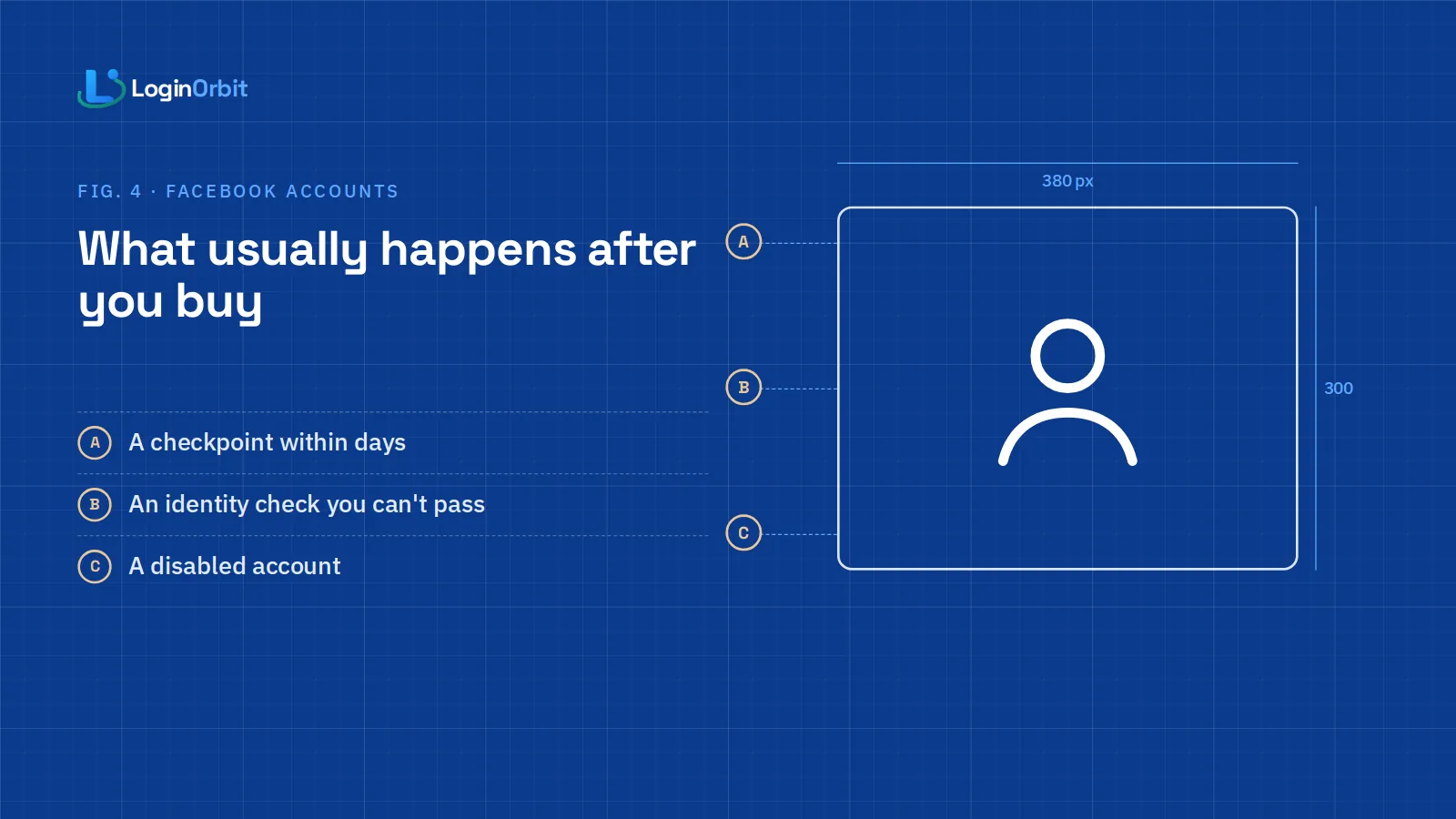
The pattern is predictable enough that it’s worth knowing before you spend money:
- A checkpoint within days. Facebook asks you to confirm a code, a phone number or your identity.
- An identity check you can’t pass. When Meta asks you to confirm your identity with an ID or a video selfie, the person in front of the screen doesn’t match the account.
- A disabled account. If it can’t be confirmed, it is often disabled, along with the groups, chats and leads you built on it.
- The original owner returns. If the account is still linked to their email or phone, they can recover it, along with your work.
- Your other accounts get linked. Logging into several bought accounts from the same device or payment method can connect them, so one restriction can spread to the others, and to your own profile.
The money is the smaller loss. The bigger one is the time and leads you put into an account that can disappear overnight.
If other accounts or tools are tied to your profile, here is how to unlink a Facebook account from apps and other accounts.
Buying aged accounts for Marketplace
Marketplace is one of the most common reasons people look for old accounts. Access to Marketplace depends on the account’s standing and history, and every listing has to follow Meta’s Commerce Policies. A bought account may show Marketplace on day one, but it can lose access as soon as the new owner starts listing products in a way that doesn’t match the account’s past.
Marketplace is also a place where buyers and sellers judge each other by profile. A profile with someone else’s history, a changed name and no real connection to your business doesn’t build trust with customers either.
If a suspicious profile contacts you about buying or selling, you can learn how to report a fake Facebook account quickly.
If Marketplace or other options are missing from the menu on your own profile, this article on Facebook menu missing options explains the causes and fixes.
Common myths about aged Facebook accounts
“More friends means more trust”
A friend list built by someone else doesn’t help you. Those people don’t know you, won’t engage with your posts, and may report you when the profile suddenly starts promoting something. Engagement from real connections matters far more than the number.
“Phone-verified accounts are safe”
A verified phone number shows the account was confirmed once, by someone. It doesn’t stop Facebook from asking the new user to confirm again, and the number may still belong to the seller.
“Tools that hide your device or location fix the problem”
Software that disguises logins doesn’t change who is behind the account, and using it to get around Meta’s checks is a policy risk in itself. It can also connect every account you manage with the same tool, so one restriction affects all of them.
“If it gets disabled, I’ll just buy another”
Each replacement starts the same cycle: new checkpoint, lost groups, lost chats, lost leads. Over a few months, the repeated cost in money and work is usually higher than building one strong profile properly.
The real cost of a bought account
The price on the listing is only the first cost. Add the leads and conversations lost when the account is disabled, the time spent rebuilding groups and contacts, the risk to your own profile and Page if the accounts get linked, and the reputation cost when prospects see a profile that looks fake. For a business that depends on Facebook for clients, these hidden costs are the ones that hurt.
Bought aged account vs. your own profile
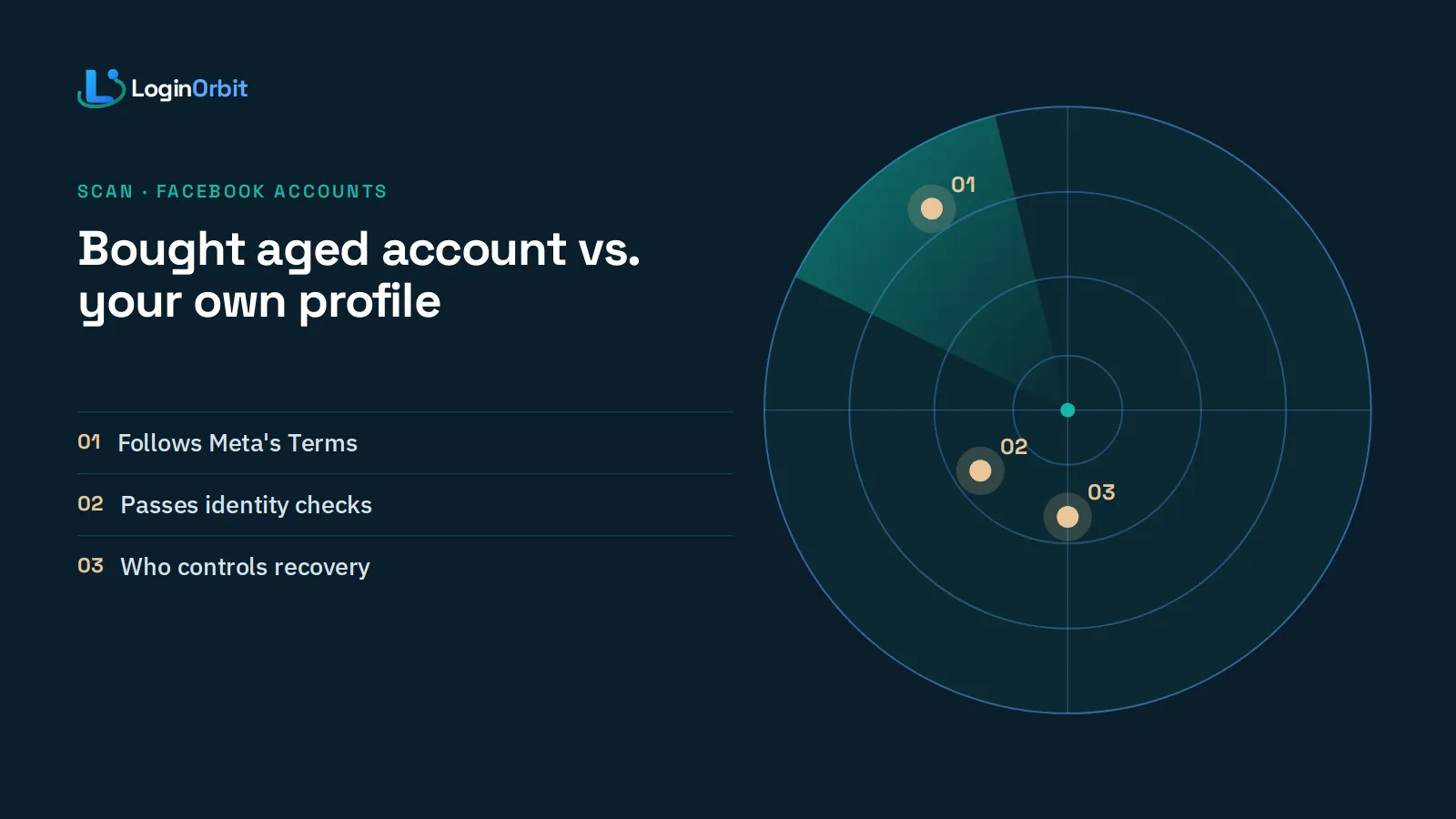
| What matters | Bought aged account | Your own profile, set up properly |
|---|---|---|
| Follows Meta’s Terms | No | Yes |
| Passes identity checks | Usually not | Yes, it’s really you |
| Who controls recovery | Often the seller or original owner | Only you |
| Outreach, groups and DMs | Until the first checkpoint | Yes, with a steady ramp-up |
| Marketplace | Can be lost after a few listings | Builds with consistent use |
| Risk to your other accounts | High, accounts can get linked | Low |
| Long-term value | Can disappear overnight | Grows over time |
Safer ways to do outreach, groups, DMs and Marketplace
Everything people try to do with a bought account can be done with accounts and tools you own. It takes a little longer to start, but it doesn’t vanish after a week.
1. Secure and complete your own profile first
Two-factor authentication, current recovery details, a real photo and complete basic information are the foundation. Our Facebook account security checklist covers every setting, and our guide on how to set up a Facebook account the right way walks through the rest.
2. Ramp up activity step by step
Start with a few group joins and personal conversations, and grow from there. Meta doesn’t publish exact limits, so anyone who promises a “safe number” of messages or requests per day is guessing. A steady, genuine pattern matters more than any number.
3. Write messages people want to receive
Personal, relevant messages get replies and few reports. Copy-paste messages sent to many strangers get reported, and those reports are what restrict outreach profiles.
4. Use your team’s own profiles, not extra fake ones
If you need more reach, spread the work across real team members, each with their own secure profile. One person should have one personal account; see how many Facebook accounts one person can have for Meta’s rules.
5. Let your Page and ads do the heavy lifting
A Facebook Page can join groups, sell, and receive messages without putting a personal profile on the line. For lead collection at scale, Meta lead ads let interested people send you their details directly, and click-to-message ads start conversations that the customer begins, which means no cold DMs and no spam reports.
6. Treat Marketplace like a shop, not a numbers game
List real products with honest photos and prices, avoid posting many near-identical listings at once, and reply to buyers quickly. A consistent selling history is what keeps Marketplace access stable.
If posts from your own profile aren't reaching people, this article on a Facebook post not showing to friends explains the usual causes and fixes.
If you can't share posts to groups or friends from your own profile, our guide on a Facebook share button missing covers the usual causes and fixes. When you can't tag people or Pages in your posts and comments, this article on Facebook tag not working explains what to check.
What if your own account is already restricted?
A restriction on your own profile is the most common reason people turn to bought accounts, and it’s also the worst time to do it. Logging into new accounts from the same device can link them to the restricted one. Go through Meta’s official review first. Our guide on what to do when your Facebook account is locked explains each step. While you wait, a second admin on your Business Manager can keep your Pages and ads running.
If the review stalls, you can contact Facebook about your account through several working options, which this guide lists.
If your own profile was turned off, this walkthrough explains how to enable a Facebook account again.
Get an outreach-ready profile without buying one
If outreach, groups, DMs or Marketplace are part of how you get clients, the lasting solution is your own profile, prepared for that work. Our Facebook account setup service includes an Outreach-Ready package: we secure and complete your profile, tune its privacy settings for outreach, and give you a step-by-step ramp-up plan for groups and messages. You make every change on your own device, and the profile stays yours.
Frequently asked questions
Is it legal to buy Facebook accounts?
Laws differ by country, but buying, selling or transferring Facebook accounts goes against Meta’s Terms of Service. Meta can disable a bought account at any time, and some accounts on sale were taken from their real owners, which can create legal problems for the buyer too.
Are aged Facebook accounts safer for outreach?
Not when they aren’t yours. Meta looks at how an account behaves, not only its age. An old account that suddenly changes owner, device, name and activity level looks like a takeover, which often leads to a checkpoint or identity check.
Why do bought Facebook accounts get disabled so fast?
The first logins come from a new device and location, the details often change, and activity jumps. Those signals trigger security checks, and the buyer can’t pass an identity check for an account that isn’t theirs.
Can I buy a Facebook account with Marketplace access?
You can find sellers offering it, but Marketplace access depends on the account’s standing and how it’s used. A bought account can lose access after a few listings. A real profile with a consistent selling history is far more reliable.
How many Facebook accounts can I have?
Meta allows one personal account per person, under the name you use in everyday life. If your business needs more reach, use your team’s own profiles, a Facebook Page and ads rather than extra personal accounts.
What is the safest way to send DMs and join groups for leads?
Use your own secure, complete profile, grow activity gradually, send personal messages rather than copy-paste ones, and follow each group’s rules. For larger volume, lead ads and click-to-message ads let interested people contact you first.
Do you sell Facebook accounts?
No. LoginOrbit doesn’t sell, rent or provide Facebook accounts. We set up and secure your own profile, including an Outreach-Ready package for lead generation, groups and DMs.
The bottom line
Buying an aged Facebook account looks like a shortcut to outreach, groups, DMs and Marketplace, but it usually ends in a checkpoint, a failed identity check and lost work. The accounts that last are the ones that belong to the person using them. Secure your own profile, grow its activity steadily, and let your Page and ads handle volume. That’s slower in the first week and far faster over a year.